WebSocket Fundamentals
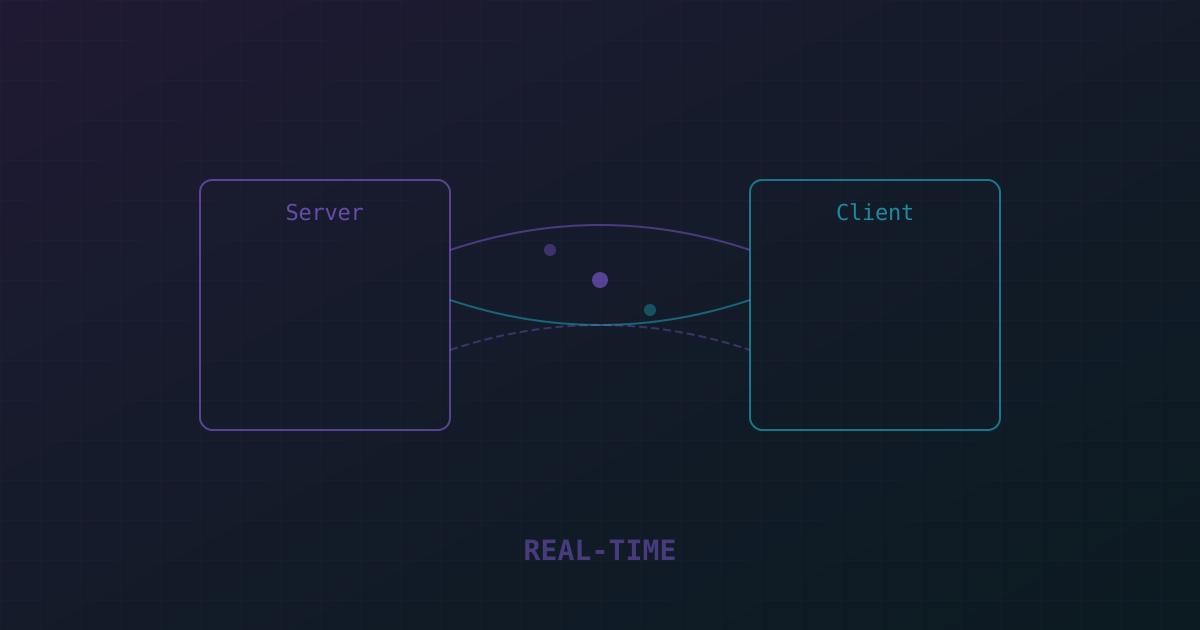
WebSockets provide full-duplex, bidirectional communication between client and server over a single TCP connection. Once the initial HTTP handshake upgrades the connection to WebSocket protocol, both sides can send messages at any time. This makes WebSockets ideal for applications where both client and server need to initiate communication: chat applications, collaborative editors, multiplayer games, and trading platforms.
The WebSocket protocol is lightweight — after the initial handshake, frames have only 2–14 bytes of overhead. This makes WebSockets efficient for high-frequency, small-message communication. Popular libraries: ws (Node.js), Socket.IO (with fallbacks), and native WebSocket API in browsers. Teams without in-house real-time expertise often bring in Node.js developers who've already solved these connection-management problems in production.
Server-Sent Events
Server-Sent Events (SSE) provide server-to-client streaming over standard HTTP. The client opens a connection and the server pushes text-based events. Unlike WebSockets, SSE is unidirectional — the server sends data, the client receives it. Client-to-server communication happens through standard HTTP requests.
SSE has three advantages over WebSockets for many use cases: it works over standard HTTP (no protocol upgrade, works with existing infrastructure), it has automatic reconnection built into the browser's EventSource API, and it's simpler to implement and scale. For live feeds, notifications, stock tickers, and monitoring dashboards, SSE is often the better choice.
Head-to-Head Comparison
WebSockets win when you need bidirectional real-time communication — chat, collaborative editing, gaming. SSE wins when you need server-to-client streaming — live feeds, notifications, progress updates. SSE is simpler to implement, works with HTTP/2 multiplexing, and integrates naturally with existing HTTP infrastructure (load balancers, CDNs, proxies). WebSockets require special handling in load balancers and proxies (sticky sessions or connection-aware routing).
Scaling WebSockets
WebSocket connections are stateful and long-lived. This creates scaling challenges: you can't simply add more servers behind a load balancer because a client's messages need to reach the specific server holding its connection. Solutions: sticky sessions (simple but limits scaling), Redis pub/sub (broadcast messages across servers), or managed services like Pusher or Ably (offload the scaling entirely).
For high-scale applications (100K+ concurrent connections), we use a fan-out architecture: application servers handle business logic and publish events to Redis, while dedicated WebSocket gateway servers maintain client connections and subscribe to Redis channels. This separates connection management from application logic. Our Node.js development team builds these gateway layers as part of larger backend engagements.
Message Ordering and Delivery Guarantees
Message ordering and delivery guarantees are the detail most teams get wrong on their first real-time feature. WebSockets guarantee in-order delivery within a single connection (TCP handles this), but if a client reconnects after a drop, any messages sent during the gap are lost unless you've built a resumption mechanism yourself — WebSockets have no built-in equivalent to SSE's Last-Event-ID header. We solve this by assigning a monotonic sequence number to every message and having the client request a replay of missed sequence numbers on reconnect, backed by a short-lived Redis buffer of recent messages per channel.
For SSE, the Last-Event-ID mechanism handles this natively, but only if your server actually implements resumption logic on the backend — the browser sends the header, but nothing happens unless your event source endpoint reads it and replays events after that ID. We've seen teams add SSE assuming reconnection "just works" and only discover the gap in production when a mobile client's connection drops during a network handoff and silently misses events.
SSE Implementation Patterns
SSE in Express or FastAPI is straightforward: set response headers (Content-Type: text/event-stream, Cache-Control: no-cache), keep the response open, and write events as formatted text. Each event has an optional event: type, data: payload, and id: for resumption. The browser's EventSource API handles reconnection automatically — if the connection drops, it reconnects and sends a Last-Event-ID header so the server can resume from where it left off.
With HTTP/2, SSE becomes even more powerful. HTTP/2 multiplexing allows multiple SSE streams over a single TCP connection, eliminating the browser's per-domain connection limit that restricted HTTP/1.1 SSE to 6 concurrent streams per domain.
Authentication for Persistent Connections
Authentication for persistent connections needs different handling than typical request-response auth. A WebSocket connection is authenticated once, at handshake time, usually via a token in the connection URL or an initial auth message, and then trusted for the connection's entire lifetime, which can be hours. If a user's permissions change or their session is revoked mid-connection, the server needs an explicit mechanism to force-disconnect that client; a revoked JWT alone won't close an already-open socket. We run a lightweight permission check on a timer, typically every 60 seconds, against active connections and disconnect any that fail, rather than relying solely on token expiry.
SSE reuses standard HTTP authentication (cookies, Authorization headers) on every reconnect, which makes revocation simpler — the next reconnect attempt is authenticated fresh — but means a long-lived SSE stream held open past a token's expiry needs the same kind of active revocation check as WebSockets if you can't tolerate a stale connection continuing to receive data after access should have ended.
Making the Choice
Default to SSE for server-to-client streaming. It's simpler, works with existing infrastructure, and handles reconnection automatically. Choose WebSockets only when you need genuine bidirectional communication — when the server needs to respond to client messages in real-time over the same connection. For most "real-time" applications (dashboards, feeds, notifications), SSE is sufficient and significantly simpler to operate at scale. If your dashboard's frontend needs the same real-time polish, our ReactJS development practice pairs well with either transport choice.