Why We Migrated
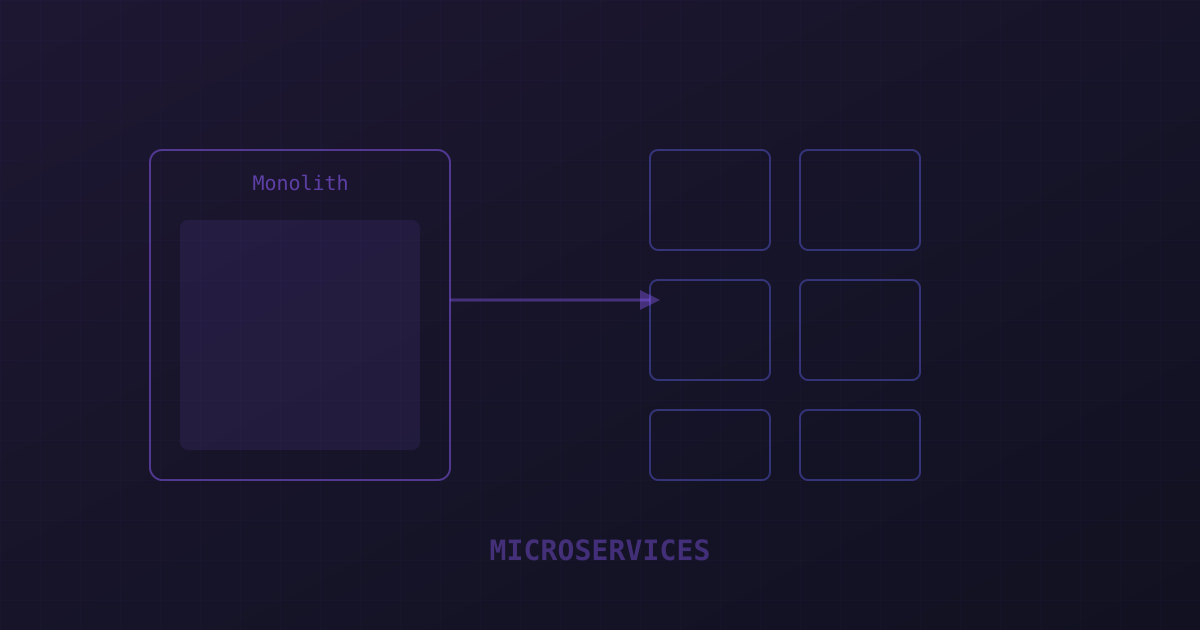
The codebase was 10 years old, 800,000 lines of PHP, and had three teams working in it simultaneously. Deployments took 45 minutes and required freezing all teams. A change to the order processing module required re-testing the user authentication module because they shared database tables. Scaling the payment processing service meant scaling the entire monolith.
These are the real reasons to migrate. Not "microservices are modern" — but team autonomy, independent scaling, and deployment velocity. If these problems don't apply to you, the monolith is usually the right choice. This exact scenario is why Laravel development engagements increasingly include an architecture review before any new feature work begins.
The Strangler Fig Pattern
We used the Strangler Fig pattern: extract services one domain at a time, routing traffic to the new service while the monolith still exists. No big-bang rewrite. The monolith shrinks until it's gone. This approach let us ship the migration incrementally, validate each service in production before moving to the next, and roll back individual services if needed.
The routing layer was a simple Nginx configuration that directed specific URL prefixes to new services. As each service went live, we updated the routing rules. The monolith never knew the services existed — it continued to serve traffic for unmigrated domains until each domain was extracted.
Finding Domain Boundaries
The hardest part of a microservices migration is domain modeling, not code writing. Splitting at the wrong boundary creates distributed monoliths: services that call each other synchronously for every operation, with all the complexity of microservices and none of the independence.
We used Event Storming — a collaborative workshop technique — with domain experts from the business to map the business processes and identify natural domain boundaries. The result surprised us: our technical module boundaries didn't match the business domain boundaries at all. The "User Service" we had planned would have been split between three business domains.
The Database Splitting Problem
Extracting services is straightforward. Splitting the shared database is where most migrations fail. A decade of shared tables, cross-domain foreign keys, and joins that cross domain boundaries make clean database separation feel impossible.
Our approach: first duplicate data, then migrate, then clean up. For each service extraction, we identified the tables it "owned" and which tables it accessed from other domains. We created read replicas of the foreign data in the new service's database, maintained synchronization via events, and only dropped the monolith's access to that data once the migration was stable.
Distributed Transactions
When a user places an order, that transaction spans three services: inventory (reserve stock), payment (charge the card), and fulfillment (create the shipment). If any step fails, you need to undo the previous steps. In a monolith, a database transaction handles this. In microservices, you need the Saga pattern.
We implemented choreography-based sagas: each service publishes events when it completes its step, and compensating events when it needs to undo. The ordering service orchestrates the happy path; each service implements its own compensation logic. This is genuinely complex — don't underestimate it.
Observability Is Not Optional
In a monolith, a request failure is visible in a single log file. In microservices, a failed order placement might involve 12 service calls across 6 services. Without distributed tracing, debugging production issues becomes archaeology.
We implemented OpenTelemetry with Jaeger for distributed tracing before we extracted our first service. Every service propagates trace context. Every request has a trace ID. When something fails in production, we can see the entire request path in Jaeger in under 30 seconds. This investment paid for itself within the first week of running microservices in production.
What We Got Wrong
We underestimated the operational overhead. Twelve services mean twelve deployment pipelines, twelve monitoring dashboards, twelve on-call runbooks. We underestimated network latency — local function calls became 2ms network calls, and two services that called each other in a tight loop suddenly had a noticeable performance impact. And we over-migrated: three services we extracted would have been better left in the monolith. Shared domain logic that's rarely independently scaled doesn't need to be a service. Our DevOps services team now leads with this operational-overhead conversation before any client commits to a migration.