Where GraphQL Excels
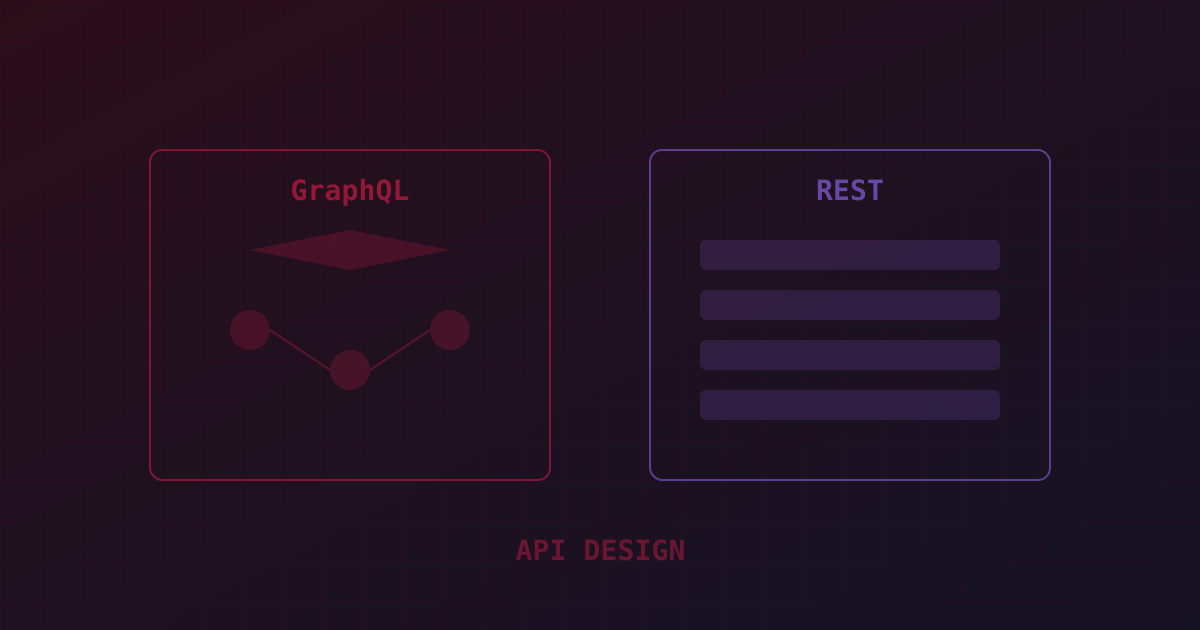
GraphQL's core value proposition remains compelling: the client requests exactly the data it needs in a single request. For applications with complex data requirements — dashboards pulling from multiple entities, mobile apps needing to minimize round-trips, or products where different clients need different data shapes — GraphQL eliminates over-fetching and under-fetching problems that plague REST APIs.
The type system is another genuine advantage. A GraphQL schema serves as a living contract between frontend and backend. Code generation from the schema produces type-safe client code that catches API mismatches at compile time, not runtime. For teams with multiple frontend clients (web, iOS, Android), this contract is invaluable.
Where REST Still Wins
REST is simpler to understand, simpler to implement, and simpler to cache. HTTP caching works out of the box with REST's resource-based URLs — a GET request to /api/users/123 is cacheable by any HTTP cache in the stack. GraphQL's single-endpoint model (/graphql) breaks standard HTTP caching, requiring client-side caching solutions like Apollo Cache.
For CRUD-heavy applications with straightforward data access patterns, REST's simplicity is a feature. A REST API with standard resource endpoints is understandable by any developer on day one. A GraphQL API requires understanding the schema, resolvers, and query patterns before being productive.
The Over-Fetching Problem
REST's over-fetching problem is real but often overstated. Well-designed REST APIs with sparse fieldsets (?fields=id,name,email) and embedded resources (?embed=orders,reviews) address most over-fetching concerns without GraphQL's complexity. The question is whether your API consumers need this flexibility frequently enough to justify GraphQL's learning curve.
GraphQL's Hidden Complexity
GraphQL shifts complexity from the client to the server. Resolver functions — the server-side functions that fetch data for each field — need careful optimization. The N+1 query problem (where resolving a list of users triggers N separate database queries for each user's orders) is the most common performance pitfall. DataLoader patterns solve this but add implementation complexity.
Authorization in GraphQL is more complex than REST. With REST, you authorize at the endpoint level. With GraphQL, you need field-level authorization — a user might have access to some fields of a resource but not others. This requires authorization checks in every resolver, which is error-prone at scale.
Query complexity is the performance risk unique to GraphQL, and it needs a mitigation strategy before launch, not after an incident. Because a single GraphQL query can traverse arbitrarily deep relationships, a malicious or careless client can construct a query that fans out into thousands of database calls in one request. We enforce query depth limits, complexity scoring — assigning a cost to each field and rejecting queries over a budget — and per-client rate limiting based on computed query cost, not just request count. Without these guardrails, a single expensive query from one client can degrade the API for everyone else.
Persisted queries solve a related production problem: sending full query text over the wire on every request adds latency and makes API traffic harder to cache at the CDN layer. With persisted queries, the client sends a hash instead of the full query text, and the server maps that hash to a pre-registered query. This also closes a security gap — clients can only execute pre-approved queries, not arbitrary ones, which matters for public-facing GraphQL APIs. Our Node.js development team applies this pattern by default on any GraphQL API exposed outside a trusted internal network. One caching nuance worth calling out: even with persisted queries, GraphQL responses still need application-level cache keys built from the query hash plus its variables, since the single /graphql endpoint gives CDNs and reverse proxies no URL-based signal to key on the way REST naturally provides.
A Decision Framework
Choose GraphQL when: you have multiple client types with different data needs; your data model has many relationships; mobile clients need to minimize network round-trips; or you're building a platform where third-party developers need flexible data access.
Choose REST when: your API is CRUD-focused; you have a single client type; HTTP caching is important; your team has limited API design experience; or you need simple, well-understood integration patterns for third-party consumers.
The Hybrid Approach
The most successful APIs we've built often combine both: REST for simple CRUD operations and webhook endpoints, GraphQL for complex read operations and dashboard data. This hybrid approach gives you REST's simplicity where it works and GraphQL's flexibility where it's needed. The implementation overhead is manageable — both can coexist behind the same API gateway with shared authentication and authorization.
Migrating an Existing REST API Gradually
Teams with an existing REST API rarely need to choose between a full rewrite and staying REST-only forever. The gradual path we recommend: stand up a GraphQL layer as a facade in front of the existing REST endpoints, using resolvers that internally call the same REST handlers your mobile and web clients already hit. This lets new clients, particularly mobile, where round-trip reduction matters most, adopt GraphQL immediately without touching the underlying REST services or their existing consumers.
Once the facade is proven, migrate individual resolvers to query the database directly instead of proxying through REST, one entity at a time, based on which resolvers show the highest latency from the double-hop. This staged approach — facade first, then selective direct implementation — has a much lower risk profile than a parallel rewrite, and it's the migration path we've used successfully across several custom software development engagements where the client couldn't accept downtime or a feature freeze during the transition.