MVC Architecture Done Right
Laravel follows the Model-View-Controller pattern with a level of clarity that keeps enterprise codebases maintainable as they grow. Models represent your data and business logic, Views handle presentation through the Blade templating engine, and Controllers orchestrate the flow between them. The framework enforces separation of concerns without being dogmatic about it.
Blade, Laravel's templating engine, compiles down to plain PHP and caches the result, so there's no runtime performance penalty. It provides template inheritance, components, and slots — everything you need to build a consistent UI across a large application without duplicating markup.
<!-- resources/views/layouts/app.blade.php -->
<!DOCTYPE html>
<html>
<head>
    <title>@yield('title', 'Enterprise App')</title>
</head>
<body>
    @include('partials.navigation')
    <main>
        @yield('content')
    </main>
    @stack('scripts')
</body>
</html>

<!-- resources/views/dashboard.blade.php -->
@extends('layouts.app')

@section('title', 'Dashboard')

@section('content')
    <h1>Welcome, {{ $user->name }}</h1>
    <x-metrics-card :metrics="$metrics" />
@endsection
Eloquent ORM: Database Made Elegant
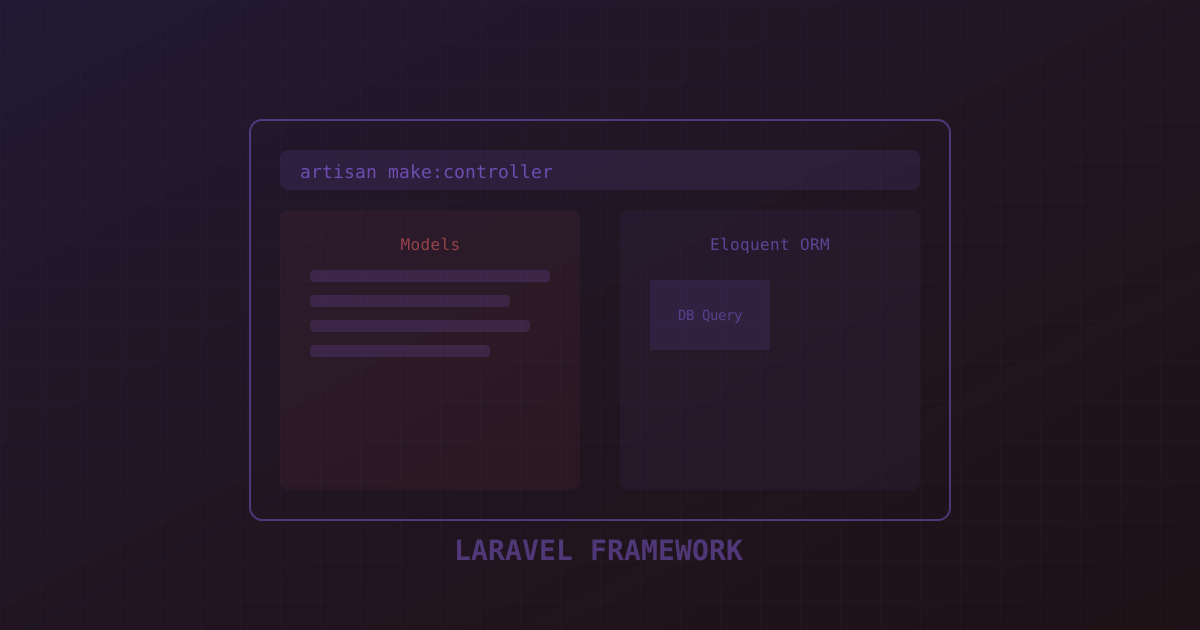
Eloquent is Laravel's ActiveRecord ORM, and it's the feature that most consistently converts developers to Laravel fans. Every database table has a corresponding Model, and Eloquent handles the CRUD operations, relationships, and query building with an expressive, chainable API.
<?php

namespace App\Models;

use Illuminate\Database\Eloquent\Model;
use Illuminate\Database\Eloquent\Relations\HasMany;
use Illuminate\Database\Eloquent\Relations\BelongsTo;

class Order extends Model
{
    protected $fillable = ['user_id', 'status', 'total_amount'];

    protected $casts = [
        'total_amount' => 'decimal:2',
        'placed_at'    => 'datetime',
    ];

    public function user(): BelongsTo
    {
        return $this->belongsTo(User::class);
    }

    public function items(): HasMany
    {
        return $this->hasMany(OrderItem::class);
    }

    public function scopePending($query)
    {
        return $query->where('status', 'pending');
    }
}

// Usage — clean, readable, expressive:
$pendingOrders = Order::pending()
    ->with('items.product')
    ->where('total_amount', '>', 100)
    ->orderBy('placed_at', 'desc')
    ->paginate(25);
Eloquent's eager loading (with()) solves the N+1 query problem that plagues many enterprise applications. Relationship definitions are explicit and type-hinted, making the codebase self-documenting. Local scopes let you encapsulate common query patterns and reuse them across the application.
Artisan CLI and Automation
Artisan is Laravel's command-line interface, and it's the backbone of developer productivity. Beyond the built-in commands for generating controllers, models, and migrations, you can create custom commands for any recurring task — data imports, report generation, queue management, or deployment hooks.
<?php

namespace App\Console\Commands;

use Illuminate\Console\Command;
use App\Services\ReportGenerator;

class GenerateMonthlyReport extends Command
{
    protected $signature = 'reports:monthly {--month= : The month to report on}';
    protected $description = 'Generate the monthly financial report';

    public function handle(ReportGenerator $generator): int
    {
        $month = $this->option('month') ?? now()->subMonth()->format('Y-m');
        $this->info("Generating report for {$month}...");

        $report = $generator->generate($month);

        $this->table(
            ['Metric', 'Value'],
            $report->summaryRows()
        );

        $this->info("Report saved to {$report->path}");
        return Command::SUCCESS;
    }
}
The php artisan make: family of generators scaffolds models, controllers, migrations, tests, mail classes, events, and more. In an enterprise project with dozens of models and hundreds of endpoints, these generators save hours of boilerplate work per sprint.
Migrations and Database Seeding
Laravel migrations are version control for your database schema. They're written in PHP — not SQL — so they're database-agnostic and reviewable in pull requests. Every developer on the team can run php artisan migrate to get their local database in sync with the latest schema.
<?php

use Illuminate\Database\Migrations\Migration;
use Illuminate\Database\Schema\Blueprint;
use Illuminate\Support\Facades\Schema;

return new class extends Migration
{
    public function up(): void
    {
        Schema::create('orders', function (Blueprint $table) {
            $table->id();
            $table->foreignId('user_id')->constrained()->cascadeOnDelete();
            $table->enum('status', ['pending', 'processing', 'shipped', 'delivered', 'cancelled']);
            $table->decimal('total_amount', 10, 2);
            $table->timestamp('placed_at')->nullable();
            $table->timestamps();
            $table->index(['user_id', 'status']);
        });
    }

    public function down(): void
    {
        Schema::dropIfExists('orders');
    }
};
Combined with database seeders and factories, you can populate your development and testing databases with realistic data in seconds. This is invaluable for enterprise teams where new developers need to get productive quickly and QA needs reproducible test data.
Built-In Security Features
Enterprise applications handle sensitive data, and Laravel provides security primitives out of the box that would take weeks to implement correctly from scratch:
- CSRF Protection: Every form submission includes a CSRF token automatically. Cross-site request forgery attacks are blocked by default.
- SQL Injection Prevention: Eloquent and the query builder use parameterized queries exclusively. Raw SQL is possible but discouraged and clearly marked.
- XSS Protection: Blade templates escape all output by default. The
{{ $variable }} syntax runs through htmlspecialchars(). Unescaped output requires the explicit {!! $variable !!} syntax.
- Authentication: Laravel Breeze and Laravel Sanctum provide ready-made authentication scaffolding with session-based auth for SPAs and API token auth for mobile clients.
- Encryption: The
Crypt facade uses OpenSSL with AES-256-CBC for all encrypted values. API keys, tokens, and sensitive config values are encrypted at rest.
Middleware and Unit Testing
Middleware in Laravel provides a clean mechanism for filtering HTTP requests. Authentication, role-based access control, rate limiting, CORS handling, and request logging are all implemented as middleware — composable, testable, and reusable across routes.
<?php

namespace App\Http\Middleware;

use Closure;
use Illuminate\Http\Request;

class EnsureUserHasRole
{
    public function handle(Request $request, Closure $next, string $role)
    {
        if (! $request->user() || ! $request->user()->hasRole($role)) {
            abort(403, 'Unauthorized');
        }

        return $next($request);
    }
}

// Register in routes:
Route::middleware(['auth', 'role:admin'])
    ->prefix('admin')
    ->group(function () {
        Route::get('/dashboard', [AdminController::class, 'index']);
        Route::get('/users', [AdminController::class, 'users']);
    });
Laravel's testing layer is built on PHPUnit and provides expressive helpers for testing HTTP endpoints, database state, and queued jobs. Feature tests simulate real requests through your application, while unit tests isolate individual classes. The RefreshDatabase trait ensures each test runs against a clean database without slowing down the suite.
/** @test */
public function admin_can_view_dashboard(): void
{
    $admin = User::factory()->admin()->create();

    $response = $this->actingAs($admin)
        ->getJson('/admin/dashboard');

    $response->assertOk()
        ->assertJsonStructure(['metrics', 'recent_orders']);
}
For enterprise teams, Laravel's combination of convention over configuration, built-in security, expressive ORM, and first-class testing support makes it one of the most productive frameworks available. It won't solve every problem — real-time applications might pair it with Laravel Reverb or Pusher, and heavy computation might be offloaded to queues — but for the core business logic of most enterprise web applications, it provides a solid, maintainable foundation. If your team needs to scale a Laravel build quickly, our Laravel developers and broader PHP development practice can step in at any stage.