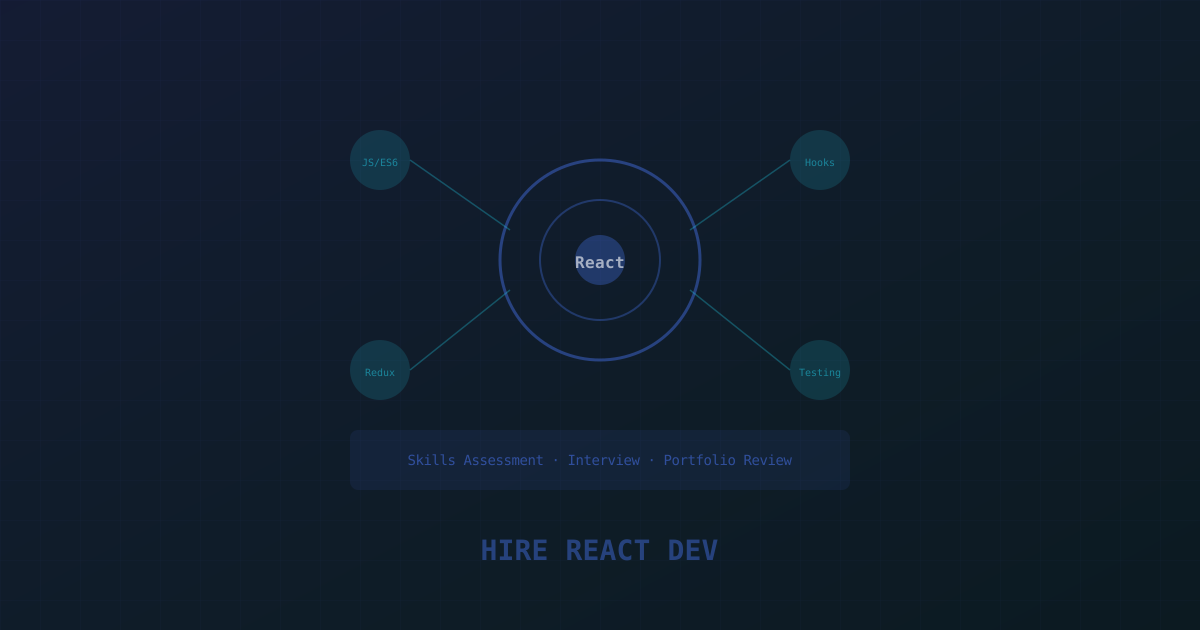
ReactJS has been the dominant frontend library for nearly a decade. Hiring a skilled React developer is not just about finding someone who knows the API — it is about finding an engineer who understands component architecture, performance optimization, and modern JavaScript. This guide gives you a technical framework for evaluation. If you'd rather skip the search entirely, we can help you hire vetted ReactJS developers who already meet this bar.
Why ReactJS Dominates Frontend Development
React's component-based architecture enables teams to build complex UIs from reusable, testable pieces. Its virtual DOM provides efficient rendering, and its ecosystem — Next.js, React Router, Redux, React Query — covers every need from routing to state management. The 2022 Stack Overflow survey shows React used by 42% of developers, far ahead of Angular (20%) and Vue (17%).
When hiring, look for developers who understand React's strengths and limitations. A senior React developer should be able to explain when to use server-side rendering versus client-side rendering, when to reach for Context API versus Redux, and how to optimize re-renders in large component trees.
Key Technical Skills to Evaluate
JavaScript and ES6+ Mastery
React is JavaScript. A developer who does not deeply understand closures, promises, async/await, destructuring, spread operators, and the event loop will struggle with React patterns. Test this with practical exercises, not trivia. Ask them to refactor a class component to hooks, or to explain why this code produces unexpected results:
// Common closure trap in loops
for (var i = 0; i < 5; i++) {
  setTimeout(() => console.log(i), 100);
}
// Outputs: 5, 5, 5, 5, 5 — not 0, 1, 2, 3, 4
// Fix: use let instead of var, or use an IIFE
React Hooks and State Management
Hooks are the modern React paradigm. Evaluate understanding of useState, useEffect, useMemo, useCallback, and useRef. Ask about the rules of hooks — why they must be called at the top level, never inside conditions or loops. For state management, check whether they understand when local state suffices, when Context API is appropriate, and when to use external libraries like Redux Toolkit, Zustand, or Jotai.
// Custom hook example — evaluate if candidate can build this
function useDebounce(value, delay) {
  const [debouncedValue, setDebouncedValue] = useState(value);

  useEffect(() => {
    const handler = setTimeout(() => {
      setDebouncedValue(value);
    }, delay);

    return () => clearTimeout(handler);
  }, [value, delay]);

  return debouncedValue;
}
REST and GraphQL Integration
Modern React apps consume APIs. Evaluate experience with React Query (TanStack Query) for server state, SWR for data fetching, and Apollo Client for GraphQL. Ask how they handle loading states, error boundaries, caching, and optimistic updates. A senior developer should prefer React Query over manual useEffect-based fetching for any non-trivial application.
Testing and Quality Assurance
Testing is non-negotiable for production React apps. Evaluate familiarity with Jest for unit tests, React Testing Library for component tests, and Cypress or Playwright for end-to-end tests. Ask them to write a test for a component that fetches data and displays a loading state. Look for testing of behavior, not implementation details.
Interview Questions with Expected Answers
Use these questions to gauge depth of understanding:
Q: What is the difference between useMemo and useCallback?
A: useMemo memoizes a computed value, useCallback memoizes a function reference. Both skip re-renders, but useMemo is for expensive calculations while useCallback is for stable function references passed to child components.
Q: How do you prevent unnecessary re-renders in React?
A: React.memo for pure components, useMemo for expensive computations, useCallback for stable function references, and proper key usage in lists. Also, lifting state down instead of up, and using state selectors to subscribe to only needed slices.
Q: Explain the useEffect cleanup function.
A: The cleanup function runs before the component unmounts and before the effect re-runs. It is used to cancel subscriptions, clear timers, or abort fetch requests to prevent memory leaks and stale state updates.
Q: When would you use useLayoutEffect instead of useEffect?
A: useLayoutEffect fires synchronously after DOM mutations but before the browser paints. Use it when you need to measure DOM elements or make visual changes that must happen before the user sees the initial render — for example, positioning a tooltip.
Evaluating Portfolios and Code Samples
Look at their GitHub. Check for: clean commit history with meaningful messages, proper folder structure, README documentation, use of TypeScript, linting configuration, and test coverage. A portfolio with three well-built projects is more impressive than ten half-finished tutorials. Ask them to walk through their most complex project — what trade-offs did they make, what would they do differently, and how did they handle performance at scale.
Salary Benchmarks and Team Structure
React developer salaries vary significantly by region and experience. In the US, mid-level React developers earn $95,000-$130,000. Senior developers command $130,000-$180,000. In India, the range is INR 8-25 lakhs depending on experience and company tier. For a complete frontend team, plan for: one senior React developer (architecture and code review), two mid-level developers (feature development), one QA engineer, and a part-time UI/UX designer. For a leaner setup, many teams instead pair a senior React developer with full-stack developers who can cover both frontend and backend work. This structure supports shipping a medium-complexity product in 3-4 months.
When hiring remotely, prioritize communication skills and timezone overlap. A brilliant developer who cannot collaborate asynchronously will slow your team down. Use pair programming sessions during interviews to evaluate real-time problem-solving and communication. For teams that would rather have this expertise built in from day one, explore our ReactJS development services instead.