What Is Composable Commerce?
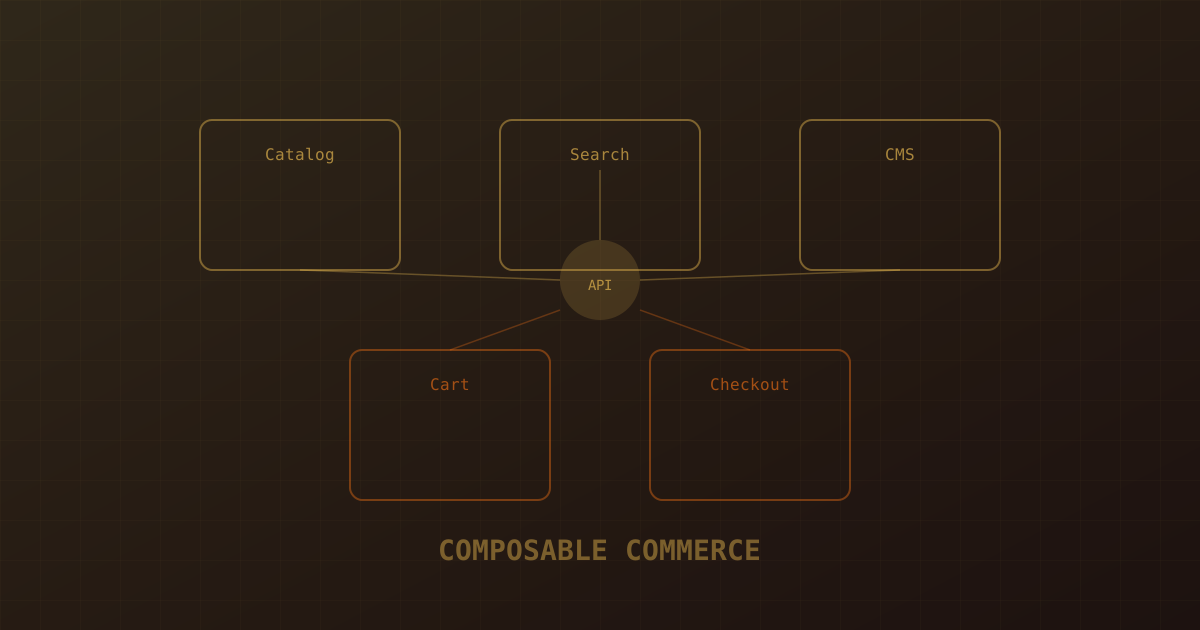
Composable commerce replaces the monolithic e-commerce platform (Shopify Plus, Salesforce Commerce Cloud, Magento) with a collection of best-of-breed services assembled via APIs. Instead of one vendor's cart, catalog, search, CMS, and checkout — you choose the best search (Algolia), the best CMS (Contentful), the best cart (Commerce Tools), and the best checkout (Stripe Checkout), then compose them into a unified experience.
The value: each component can be replaced independently. When a better search provider emerges, you swap search without rebuilding your catalog. When you expand to a new market, you add a localized CMS without touching checkout. This composability is the antidote to vendor lock-in. It's a pattern we implement often in our e-commerce development engagements for brands outgrowing a single monolithic platform.
MACH Architecture Principles
Composable commerce follows MACH principles: Microservices (each business capability is an independent service), API-first (all functionality is exposed via APIs), Cloud-native (SaaS delivery with automatic updates), and Headless (frontend is decoupled from backend). Each principle is independently valuable but together they create an architecture that's genuinely flexible.
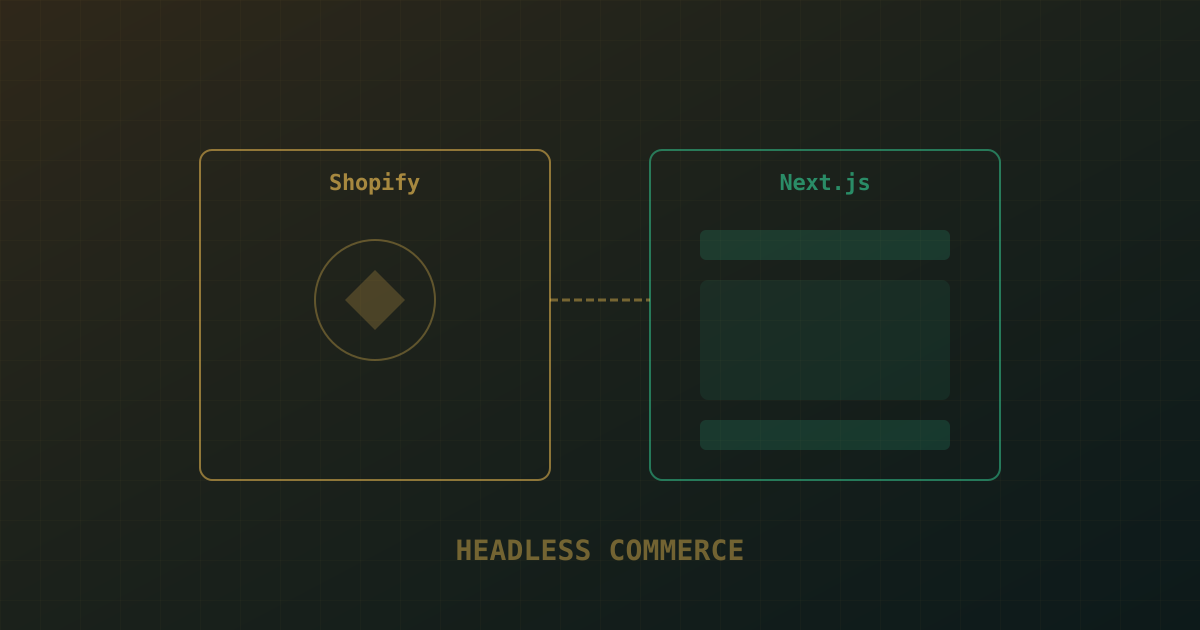
The microservices principle means each vendor service owns one business capability. The API-first principle means integration is through well-documented APIs, not database access or file transfers. Cloud-native means you don't manage infrastructure. Headless means your frontend is a separate application that consumes APIs — enabling any frontend technology and any touchpoint (web, mobile, IoT, voice).
Build vs Buy Decisions
Not every component should be bought. The decision framework: buy commodity capabilities (search, CMS, email), build differentiating capabilities (unique product configuration, custom pricing logic, proprietary recommendation algorithms). The test: if a capability doesn't give you competitive advantage, buy it. Your engineering time should be spent on what makes your business unique.
Orchestration Layer
The orchestration layer is the glue that composes individual services into a unified commerce experience. It handles cross-service workflows (add to cart → update inventory → trigger recommendation recalculation), data consistency (eventual consistency between services), and frontend API aggregation (combining data from multiple services into single frontend queries).
We implement orchestration as a Backend-for-Frontend (BFF) layer using Next.js API routes or a dedicated Node.js service. The BFF aggregates data from catalog, pricing, inventory, and promotion services into the shape the frontend needs. This keeps the frontend simple — it makes one GraphQL or REST call instead of five.
Data Consistency Across Services
Data consistency across composed services is the operational cost most teams underestimate when they see the architecture diagram for the first time. In a monolith, a single database transaction keeps inventory, pricing, and cart in sync automatically. In a composable architecture, those three concerns live in three different vendor systems with three different consistency models, and a failure partway through a multi-service operation — say, inventory decrements but the order service call times out — needs an explicit reconciliation strategy, not just a retry.
We handle this with an event-driven saga pattern: each step in a cross-service workflow publishes an event on completion, a saga orchestrator tracks the workflow's state, and if a step fails, compensating events roll back the steps that already succeeded, rather than leaving the system in a half-completed state. This adds real engineering effort compared to a monolith's ACID transactions, and it's the single biggest reason composable commerce projects run over their initial timeline estimate when this pattern isn't planned for from the start.
Migration from Monolith
Migrating from a monolithic platform to composable commerce should follow the strangler fig pattern: extract one capability at a time while the monolith continues to serve. Start with the easiest extraction — usually the CMS or search — and progressively replace capabilities. The monolith handles checkout and cart until those services are validated in production.
The catalog migration is the hardest. Product data in monolithic platforms is deeply intertwined with pricing, inventory, and categories. Extract the catalog first as a read-only service, then migrate write operations once the read path is validated.
Vendor Selection Criteria Beyond Feature Lists
Vendor selection for a composable stack should go well beyond a feature comparison spreadsheet. The questions that matter more than feature parity: what are the vendor's actual API rate limits under your expected traffic, not their marketing page's numbers; how does the vendor handle webhook delivery failures and do they provide replay; what's their historical uptime and incident communication track record; and critically, how painful is it to migrate away from this vendor if it underperforms in eighteen months. Composable commerce's core promise is replaceability, but that promise is only real if you've verified the exit path during vendor selection, not after you're locked in.
We run a structured vendor evaluation for every composable engagement: a two-week proof-of-concept against real, not demo, data volumes for each candidate in a category, specifically to surface rate-limit and latency issues that never show up in a sales demo. This upfront diligence costs two to three weeks per major vendor decision, which feels slow compared to just signing with whichever platform your team has already used before, but it consistently pays for itself the first time a vendor has an outage during a peak sales event and you already know the fallback plan.
When Composable Is Wrong
Composable commerce adds operational complexity. For businesses under $5M annual revenue, a well-configured Shopify Plus instance typically delivers better ROI. Composable makes sense when: you have multiple sales channels requiring different frontends; you need capabilities that no single platform provides; you're expanding internationally with market-specific requirements; or your engineering team has the maturity to operate distributed systems. If these don't apply, stay monolithic. This trade-off comes up constantly across our work in the e-commerce industry.