The metaverse is no longer science fiction — it is a growing ecosystem of persistent virtual worlds, augmented reality experiences, and digital economies. For businesses, it represents a new channel for customer engagement, employee training, product visualization, and brand presence. This guide provides a technical overview and strategic framework for entering the metaverse. We help businesses translate this potential into shippable products through our metaverse development practice.
The metaverse is a collective virtual shared space, created by the convergence of persistent virtual worlds, augmented reality, and the internet. It is not a single platform — it is an ecosystem of interoperable environments where users can work, play, socialize, and transact. Key technical characteristics include: persistence (the world continues to exist when you leave), interoperability (assets and identity move between environments), real-time interaction, and a functioning economy (digital goods, NFTs, virtual real estate).
From a technical perspective, the metaverse is built on three layers: the infrastructure layer (cloud computing, 5G, edge computing), the platform layer (game engines, VR/AR SDKs, blockchain), and the experience layer (virtual worlds, AR applications, digital twins).
Several platforms dominate the metaverse landscape, each with different strengths:
Meta Horizon Worlds: The largest VR-based metaverse, built on Oculus/Meta Quest hardware. Best for social experiences and brand activations. Limited to Meta's ecosystem — no cross-platform interoperability. Development uses Meta's proprietary tools.
Decentraland: A blockchain-based virtual world running on Ethereum. Users own virtual land as NFTs and can build experiences using the Decentraland SDK (TypeScript). Fully decentralized governance through a DAO. Best for brands wanting Web3 integration and digital ownership.
Spatial: Focuses on enterprise use cases — virtual meetings, training, and collaboration. Integrates with Microsoft Teams and supports WebXR for browser-based access without VR hardware. Best for B2B applications and remote work.
Roblox: While primarily a gaming platform, Roblox has metaverse characteristics — persistent worlds, user-generated content, and a digital economy (Robux). Best for reaching younger demographics and experiential marketing.
Development Frameworks and Tools
Building metaverse experiences requires specialized tools. The primary frameworks are:
Unity: The most widely used game engine for metaverse development. Supports VR (Oculus, SteamVR), AR (ARKit, ARCore), and WebGL. C# scripting, extensive asset store, and strong community. Our Unity development team builds most enterprise metaverse projects on this engine for exactly these reasons.
Unreal Engine: Epic Games' engine offers superior graphics fidelity — Nanite virtualized geometry and Lumen global illumination. Blueprint visual scripting makes it accessible to non-programmers. Best for high-fidelity experiences and large-scale virtual worlds.
WebXR: A web standard for VR and AR experiences that run in the browser. No app download required. Use Three.js, A-Frame, or Babylon.js for development. Best for broad reach and low-friction experiences.
// A-Frame WebXR example — a simple virtual showroom
<a-scene>
  <a-assets>
    <a-asset-item id="product" src="/models/product.glb"></a-asset-item>
  </a-assets>

  <a-sky color="#ECECEC"></a-sky>
  <a-entity gltf-model="#product" position="0 1.5 -3" rotation="0 45 0">
    <a-animation attribute="rotation" to="0 405 0" dur="5000" repeat="infinite">
    </a-animation>
  </a-entity>

  <a-entity cursor="fuse: true; fuseTimeout: 500"
            position="0 1.6 -1"
            geometry="primitive: ring; radiusInner: 0.02; radiusOuter: 0.03"
            material="color: cyan; shader: flat">
  </a-entity>
</a-scene>
Use Cases by Industry
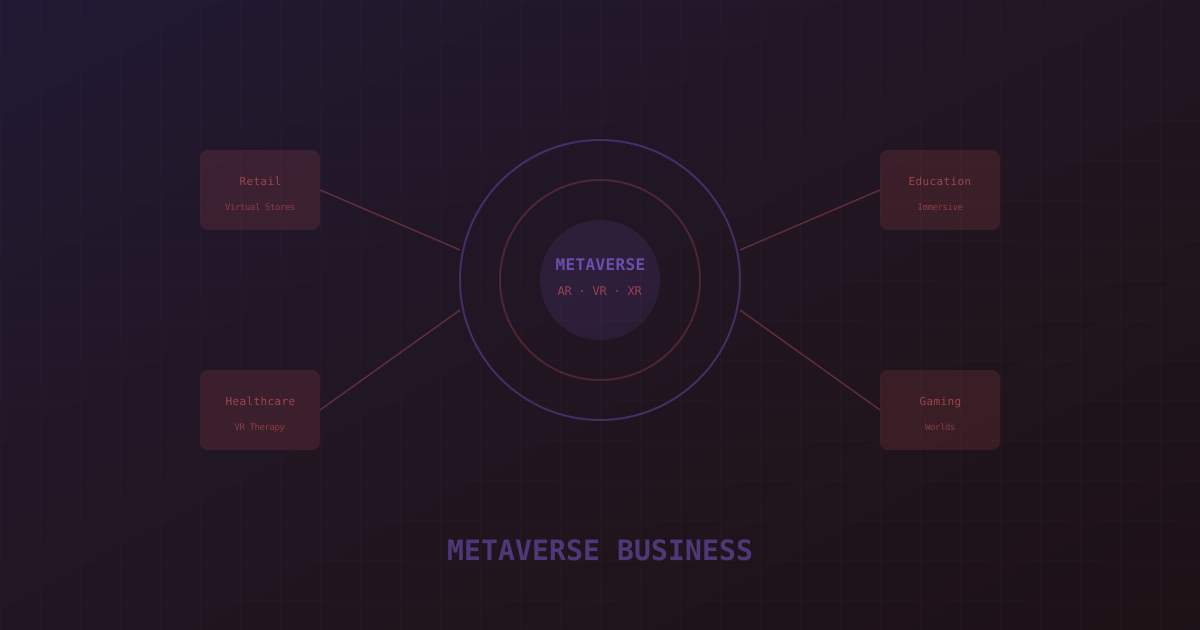
Retail and E-commerce: Virtual showrooms let customers browse and purchase products in 3D. Nike launched Nikeland on Roblox, attracting 36 million visitors in the first year. Gucci Garden on Roblox saw virtual items resell for more than physical counterparts.
Education and Training: Virtual classrooms and simulation-based training. Medical students practice surgery in VR. Walmart uses VR to train employees on Black Friday crowd management. Strivr reports 70% faster training compared to traditional methods.
Healthcare: Virtual therapy sessions, pain management through VR distraction, and physical rehabilitation with gamified exercises. AppliedVR reported a 46% reduction in pain scores for chronic pain patients using VR therapy — a pattern we've also seen play out across other healthcare clients experimenting with immersive care models.
Fitness and Wellness: Supernatural (acquired by Meta) offers immersive VR workouts. Peloton explored virtual cycling classes. The fitness metaverse combines gamification with exercise to improve adherence.
Implementation Roadmap
Entering the metaverse requires a phased approach. Phase 1 (Months 1-2): Strategy and platform selection. Define your goals — brand awareness, customer engagement, employee training, or new revenue streams. Choose the platform that aligns with your audience and objectives.
Phase 2 (Months 2-4): Prototype and MVP. Build a minimal experience to test with a small user group. Focus on core interactions — navigation, object manipulation, and social features. Gather feedback and iterate.
Phase 3 (Months 4-6): Production and launch. Polish the experience, integrate analytics, implement moderation and safety features, and plan your marketing campaign. Launch with a PR push and influencer partnerships.
Phase 4 (Ongoing): Iterate and expand. Add new features based on user data, expand to additional platforms, and build a community around your metaverse presence.
Cost Considerations and ROI
Metaverse project costs vary widely. A simple WebXR experience costs $15,000-$50,000. A full VR app development engagement built in Unity costs $50,000-$200,000. A persistent virtual world with multiplayer features costs $200,000-$1,000,000+. Ongoing costs include hosting, content updates, moderation, and community management.
ROI metrics differ from traditional digital channels. Track engagement time (average session length), social sharing (user-generated content and word-of-mouth), brand sentiment (surveys and social listening), and direct revenue (virtual goods sales, ticketed events). Early metaverse adopters report 2-5x higher engagement than traditional digital campaigns, but the audience is still niche — plan for long-term brand building rather than immediate revenue.