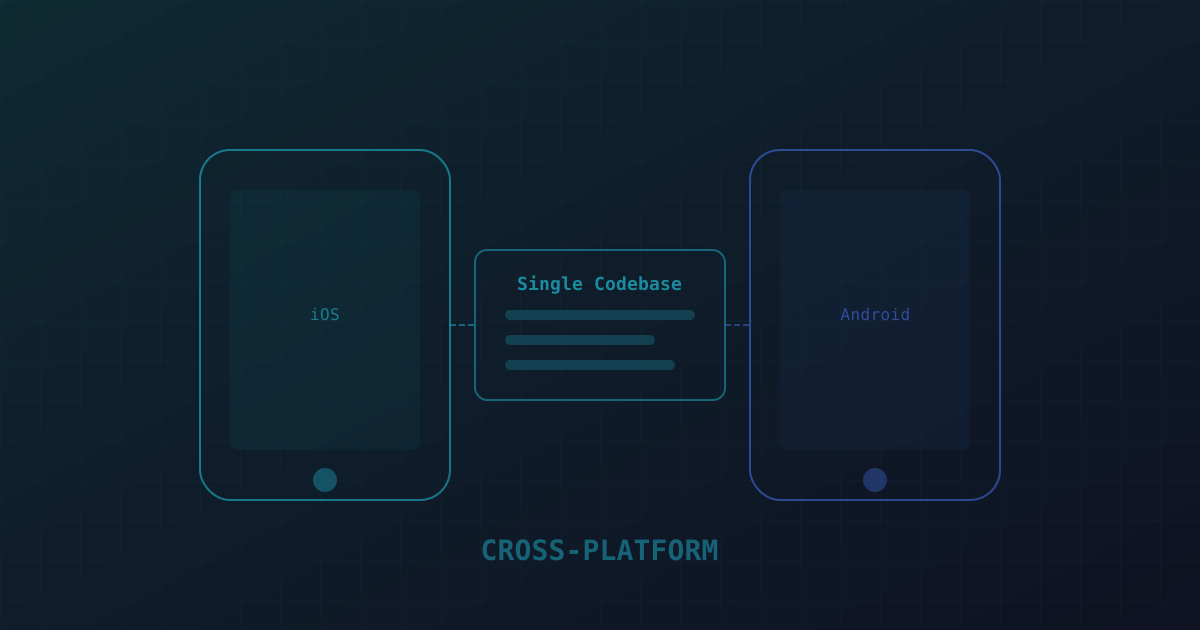
Mobile app development has historically meant building two separate applications — one for iOS in Swift, one for Android in Kotlin. For startups and mid-size businesses, this doubles the engineering cost, stretches timelines, and creates a maintenance burden that compounds with every feature release. Cross-platform development frameworks solve this by letting you write once and deploy to both platforms from a single codebase.
The market has matured significantly. Flutter, React Native, and even .NET MAUI now deliver experiences that are visually indistinguishable from native for the majority of app categories. The question is no longer whether cross-platform can match native quality, but when it makes strategic sense for your business.
Code Reusability and Real Cost Reduction
The headline promise of cross-platform is code reuse, and the numbers bear it out. In our projects at iMOBDEV, a typical cross-platform app achieves 80-90% code sharing between iOS and Android. The remaining 10-20% covers platform-specific integrations like push notification configuration, biometric authentication, and deep linking.
Consider a mid-complexity app with user authentication, a social feed, real-time chat, and payment integration. A native build for both platforms would require approximately 1,800-2,200 engineering hours. The same app built with Flutter or React Native typically requires 1,100-1,400 hours — a reduction of 35-40%. At blended engineering rates of $80-120/hour, that translates to $56,000-$96,000 in savings on a single project.
Maintenance costs follow the same ratio. When you ship a bug fix or a new feature, you update one codebase instead of two. Over a two-year product lifecycle, maintenance typically accounts for 40-60% of total development cost, so the compounding savings are substantial.
Flutter vs React Native vs Native
The three realistic options for a new mobile project in 2024 are Flutter, React Native, and going fully native with Swift and Kotlin. Each has distinct trade-offs:
Flutter (Dart) renders its own UI using the Skia engine, giving you pixel-perfect consistency across platforms. It excels at custom UI, animation-heavy apps, and MVPs where speed-to-market is critical. The widget tree model means your UI is declarative and highly composable. The trade-off is a larger app binary size (typically 15-25MB vs 8-12MB for native) and a Dart learning curve for teams coming from JavaScript or Swift.
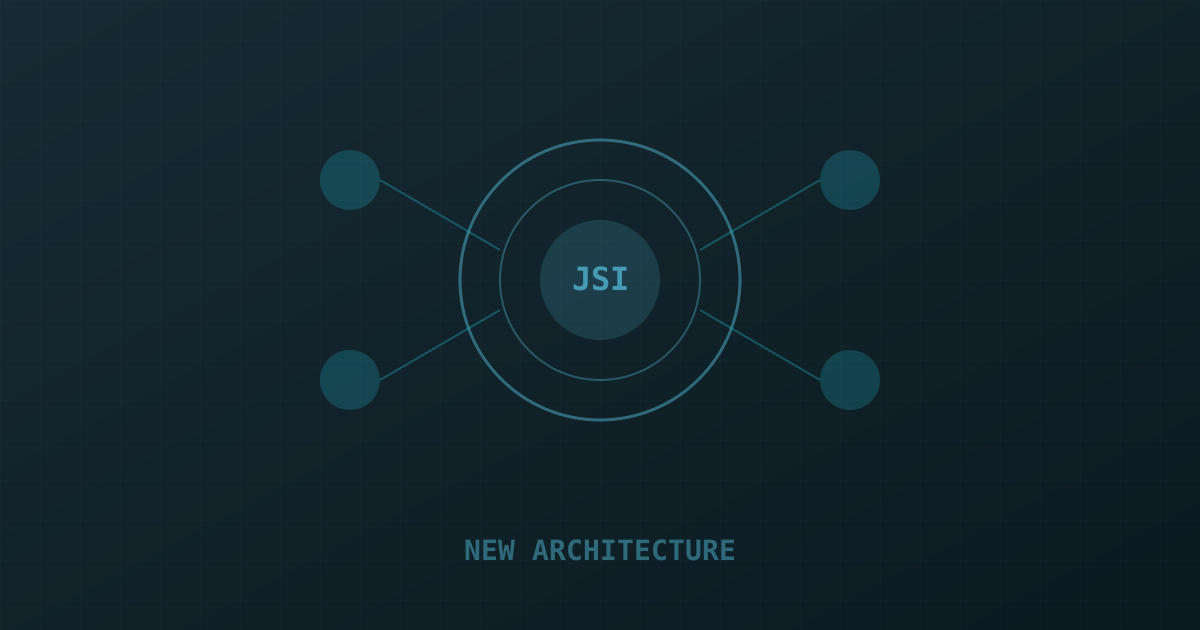
React Native (JavaScript/TypeScript) uses native platform components rendered through a JavaScript bridge (or the newer Fabric architecture with JSI). It's ideal when your team already has strong React or JavaScript expertise. The ecosystem is vast — libraries like React Navigation, Expo, and Realm provide production-ready solutions for most common requirements. The trade-off is occasional bridge performance issues in animation-heavy screens and a more complex debugging experience.
Native (Swift + Kotlin) gives you maximum performance, smallest binary size, and immediate access to every platform API on day one. It's the right choice for apps that are deeply tied to platform capabilities — ARKit, complex camera pipelines, heavy background processing, or system-level integrations. The cost is roughly 1.8-2x the development effort of a cross-platform approach.
Performance is where the cross-platform debate gets heated. Here's what we measure in real projects:
Metric                  | Native (Swift) | Flutter    | React Native
------------------------|----------------|------------|-------------
Cold start time         | 320ms          | 480ms      | 550ms
Frame rate (scroll)     | 60fps stable   | 60fps      | 55-60fps*
Memory (idle)           | 45MB           | 78MB       | 95MB
Binary size (minimal)   | 8MB            | 16MB       | 12MB
JS-to-native bridge     | N/A            | N/A        | 0.3-2ms/call
*React Native with the new Fabric architecture and Hermes engine narrows the gap significantly. For most business applications — e-commerce, social, productivity, content — these differences are imperceptible to users. They matter for games, real-time video, and apps with complex gesture-driven animations.
When to Choose Cross-Platform
Cross-platform is the right strategic choice when:
- You're building an MVP or validating a market. Speed-to-market matters more than shaving 100ms off startup time. Get both apps live in 3-4 months instead of 6-8.
- Your app is content-driven or transaction-driven. E-commerce, media, social, booking, and fintech apps are overwhelmingly UI and API integration. Cross-platform handles these beautifully.
- Your team is small. A team of 3-4 developers maintaining two native codebases will burn out. One shared codebase means shared context, shared ownership, and faster iteration.
- You need visual consistency. If your brand demands identical UI on both platforms, Flutter's custom rendering engine is a significant advantage over React Native's native-component approach.
Go native when your app is fundamentally a platform experience — think camera-first apps, AR applications, system utilities, or games that need GPU-level access. If your app's core value proposition depends on a platform-specific API that cross-platform wrappers don't yet support well, native is the pragmatic choice.
Deployment Strategies and Maintenance
Cross-platform apps share a single codebase but still deploy through each platform's native pipeline — App Store Connect for iOS and Google Play Console for Android. With Flutter, you run flutter build ipa and flutter build appbundle separately. With React Native, you use xcodebuild and ./gradlew assembleRelease. CI/CD tools like Fastlane, Codemagic, and GitHub Actions can automate both pipelines from a single repository.
Code Push (for React Native) and Shorebird (for Flutter) enable over-the-air updates for JavaScript and Dart code respectively, letting you push bug fixes without waiting for store review. This is a significant operational advantage for rapid iteration.
Long-term maintenance is where cross-platform truly shines. When React releases a new version or Apple deprecates an API, you fix it once. In a native dual-codebase setup, you're tracking two dependency graphs, two release cycles, and two sets of breaking changes. For teams operating at scale, this reduction in operational complexity is often the deciding factor.
The bottom line: cross-platform development is not a compromise — it's a strategic decision to optimize for speed, cost, and maintainability. For the majority of business applications in 2024, Flutter and React Native deliver 90% of the native experience at 60% of the cost. The remaining 10% only matters if your app's core value depends on it. If you're ready to build, our Flutter developers can help you scope the right approach.