Programming Model Differences
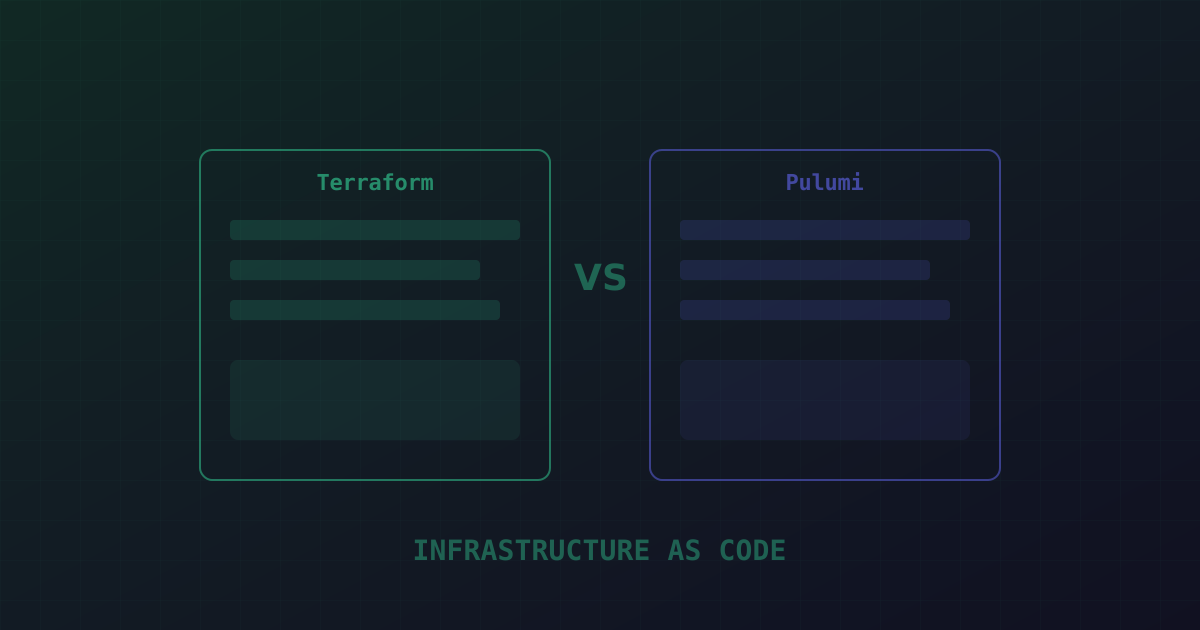
Terraform uses HCL (HashiCorp Configuration Language) — a declarative, domain-specific language designed for infrastructure. You describe what resources you want and Terraform figures out the dependency graph and provisioning order. HCL is simple to learn but limited — no loops (only for_each), no conditionals beyond basic expressions, no functions beyond built-ins.
Pulumi uses general-purpose programming languages (TypeScript, Python, Go, Java, C#). You write real code with loops, conditionals, functions, and abstractions. This means you can create reusable components, write unit tests with familiar frameworks, and apply software engineering practices that HCL makes difficult. The trade-off: Pulumi programs are more powerful but also more complex — there are more ways to write bad Pulumi code than bad Terraform.
State Management
Both tools maintain state — a record of what resources exist and their current configuration. Terraform's state is a JSON file stored remotely (S3, Terraform Cloud). Pulumi's state is stored in Pulumi's managed service (free tier available) or self-hosted in any object store. Both support state locking to prevent concurrent modifications.
The state management experience is similar in practice. Terraform's state files are human-readable JSON, which helps with debugging. Pulumi's state is also JSON but less commonly inspected directly — the CLI provides better introspection tools.
Team Workflow
Terraform's ecosystem is more mature for team workflows. Terraform Cloud/Enterprise provides remote state, run triggers, policy enforcement (Sentinel), and a private module registry. The open-source Terraform workflow (plan → apply with GitOps) is well-understood and supported by every CI/CD platform.
Pulumi's team workflow is improving but less battle-tested. Pulumi's managed service provides similar features (state, audit logs, policy via CrossGuard), but the ecosystem of third-party integrations is smaller. For teams already invested in Terraform's ecosystem, migration to Pulumi has organizational overhead beyond the technical change. Our DevOps services team runs this exact evaluation, alongside broader AWS consulting work, before recommending a tool for a new client's infrastructure.
Testing Infrastructure Code
This is where Pulumi's programming model shines. Pulumi programs can be tested with standard unit testing frameworks — Jest for TypeScript, pytest for Python. You can test that your infrastructure code produces the expected resources with the expected configuration without deploying anything. Terraform testing is improving (terraform test framework) but remains limited compared to testing real code.
Integration testing (deploying to a test account and validating) is possible with both tools. Tools like Terratest (Go) work with both Terraform and Pulumi for end-to-end infrastructure testing.
Choose Terraform when: your team is already familiar with it; you need the broadest provider ecosystem (Terraform has 3,000+ providers); you want the most mature GitOps workflow; or your infrastructure is relatively straightforward and HCL's limitations don't constrain you. Terraform is the safe, well-supported choice.
When Pulumi Wins
Choose Pulumi when: your team prefers general-purpose languages; you need complex infrastructure logic (conditional resources, dynamic naming, computed configurations); you want to apply software engineering practices (testing, abstraction, versioning) to infrastructure; or you're building a platform that other teams consume and need to provide typed, component-based infrastructure abstractions.
Migrating Between Tools (or Running Both)
Migrating an existing Terraform codebase to Pulumi, or the reverse, is more disruptive than the marketing materials from either vendor suggest. Pulumi's import tooling can generate Pulumi code from existing Terraform state, but the generated code is rarely idiomatic — it needs a real refactoring pass to take advantage of the abstractions that justified the migration in the first place. We treat any IaC migration as its own scoped project with its own testing plan, not a side effect of a broader infrastructure initiative, because half-migrated infrastructure with two competing sources of truth for the same resources is worse than staying on the original tool.
The more common real-world scenario isn't a full migration but a hybrid state: teams adopt Pulumi for new, complex infrastructure — a Kubernetes platform, a multi-region setup with heavy conditional logic — while leaving stable, low-churn infrastructure on Terraform. This is a reasonable long-term steady state, not just a transition phase, as long as team documentation is explicit about which tool owns which resources — the failure mode we've seen is two engineers independently trying to manage the same VPC from both tools.
Real Cost and Adoption Considerations
The cost consideration people underweight is engineer time, not licensing. Terraform's open-source CLI and Pulumi's free tier are both free for small teams, so the real cost comparison is ramp-up time and long-term maintenance burden. A team of experienced software engineers who don't already know Terraform will often be productive in Pulumi faster, since they're writing in a language they already know instead of learning HCL's declarative model and its specific quirks. A team of infrastructure specialists who've invested years in Terraform will be more productive staying there, since the switching cost isn't the syntax — it's rebuilding years of accumulated modules, CI patterns, and tribal knowledge about provider-specific edge cases.
For clients without a strong existing preference, our DevOps services team defaults to Terraform for straightforward multi-cloud provisioning and reserves Pulumi for engagements where the infrastructure logic itself is complex enough to justify a general-purpose language — usually when the client's platform team will maintain and extend the codebase long after our engagement ends. Provider ecosystem breadth is the other practical factor worth weighing before committing: Terraform has had a multi-year head start building out third-party provider coverage, and for niche SaaS platforms or less common cloud services, that provider almost always exists for Terraform first and sometimes only for Terraform, which can quietly decide the choice regardless of language preference.