Enterprise vs Public Blockchain
Enterprise blockchain solves a different problem than public blockchain. Public blockchains (Ethereum, Bitcoin) solve trustless consensus among anonymous participants. Enterprise blockchain solves trusted consensus among known participants who still need auditability, privacy, and shared process automation. The participants are known, the rules are agreed upon, and the blockchain provides an immutable, shared record that no single party controls.
The value proposition: when three companies share a business process (supply chain, trade finance, insurance claims), each currently maintains their own records. Reconciliation is manual, expensive, and error-prone. A shared blockchain provides a single source of truth that all parties trust because no single party controls it.
Hyperledger Fabric Architecture
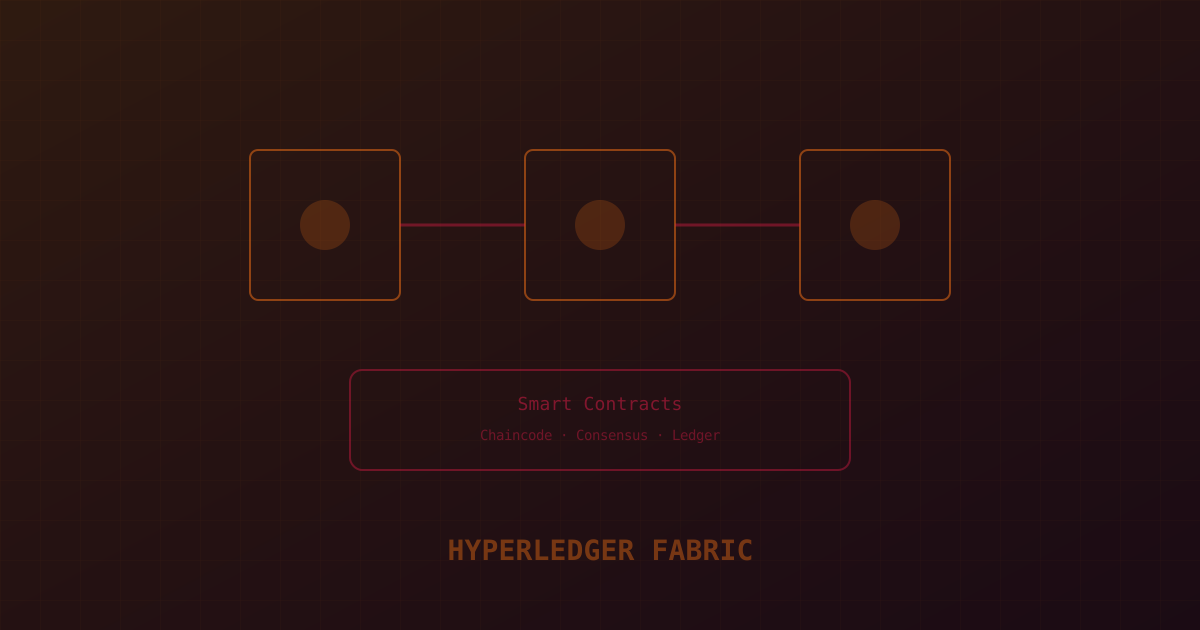
Fabric's architecture differs from other blockchain platforms in three ways: permissioned membership (only authorized organizations can participate), channel-based privacy (transactions are visible only to channel members), and chaincode execution isolation (smart contracts run in Docker containers, separate from the ordering service). The ordering service (Raft or BFT consensus) sequences transactions without executing them — execution happens on peer nodes after ordering.
This separation of ordering and execution enables higher throughput than platforms that combine them. Fabric networks in production handle 1,000–3,000 transactions per second, compared to Ethereum's 15–30 TPS (pre-L2).
Channels and Privacy
Channels are Fabric's privacy mechanism. A channel is a private blockchain subset — only organizations invited to the channel can see its transactions. A supply chain network might have a main channel for all participants and private channels for supplier-manufacturer negotiations that shouldn't be visible to competitors on the same network.
Private Data Collections go further: within a channel, specific transactions can be restricted to a subset of organizations. The transaction hash is recorded on the channel ledger (proving the transaction occurred) but the actual data is stored only on the authorized organizations' peers. This is essential for competitive business scenarios where parties share a process but not their proprietary data.
Chaincode (Smart Contracts)
Fabric's smart contracts (chaincode) can be written in Go, Java, or JavaScript/TypeScript. Chaincode defines the business logic — what transactions are valid, what state changes they produce, and what access controls apply. Unlike Ethereum's Solidity, chaincode runs in Docker containers with full language runtimes — you can use any library available in your chosen language.
The chaincode lifecycle supports upgrades without network downtime. A new chaincode version is installed on peers, then defined through an endorsement policy that requires a specified number of organizations to approve before the upgrade takes effect. This governance model is essential for enterprise adoption — no single organization can unilaterally change business rules.
Real Enterprise Use Cases
We've implemented Fabric for three enterprise use cases through our Hyperledger development practice. Supply chain traceability: a food manufacturer tracking ingredients from farm to factory, with each party (farm, logistics, processor) recording certifications and handoffs on the blockchain. Trade finance: a bank, exporter, and importer sharing letter-of-credit documents with automated compliance checks. Healthcare: hospitals sharing patient consent records for clinical trials with auditable, tamper-proof consent tracking — a pattern that fits naturally into healthcare compliance requirements.
Deployment and Operational Considerations
Running a Fabric network in production requires operational discipline most teams underestimate going in. Each participating organization runs its own peer nodes and maintains its own certificate authority, or delegates to a managed CA. Network governance — who can add a new organization, who approves chaincode upgrades, who operates the ordering service — needs to be decided and encoded into the channel configuration before launch, not negotiated after a dispute arises. We draft a governance charter alongside the technical architecture for every enterprise Fabric engagement, because the technology enforces whatever rules the participants agreed to, and vague agreements produce technically-correct-but-unusable networks.
Monitoring a permissioned network differs from monitoring a public chain: there's no block explorer ecosystem to lean on. We instrument peer and orderer nodes with Prometheus metrics — block commit latency, endorsement failures, gossip protocol health — and build a custom dashboard per client, since off-the-shelf Fabric monitoring tooling is thinner than the Ethereum ecosystem's.
Common Migration Pitfalls
The most common mistake we see in early Fabric deployments is under-provisioning the endorsement policy. Teams often default to requiring only one organization's endorsement for speed, then discover during an audit that this doesn't meet the non-repudiation guarantees regulators expect. We set endorsement policies to require a majority of business-critical organizations from day one, even though it adds latency, because relaxing a policy later requires a network-wide upgrade that's far more disruptive than starting strict.
A second common pitfall: treating chaincode like a normal microservice deployment. Chaincode changes go through the full lifecycle — package, install on every peer, approve from each organization, and commit — which takes longer than a typical CI/CD deploy. Teams that don't budget for this lifecycle in their release calendar end up rushing endorsement approvals, which defeats the governance model's entire purpose. We also recommend a quarterly governance review meeting between all participating organizations for the first year of any production network — most disputes we've seen trace back to an assumption one party made that was never actually written into the channel configuration.
When Blockchain Is the Right Choice
Blockchain is the right choice when: multiple parties share a business process; no single party should control the shared record; reconciliation between parties is expensive; auditability is a regulatory requirement; and the shared process has business rules that can be automated through smart contracts. If a shared database with appropriate access controls solves the problem, use a shared database — it's simpler and faster. Blockchain adds complexity; use it only when that complexity is justified by the trust and auditability requirements. Our private blockchain development and broader blockchain development teams run this assessment with every new enterprise client before recommending Fabric over a conventional database.